Biological Naturalism
& Artificial Consciousness
The Rise and Fall of Agent Civilizations
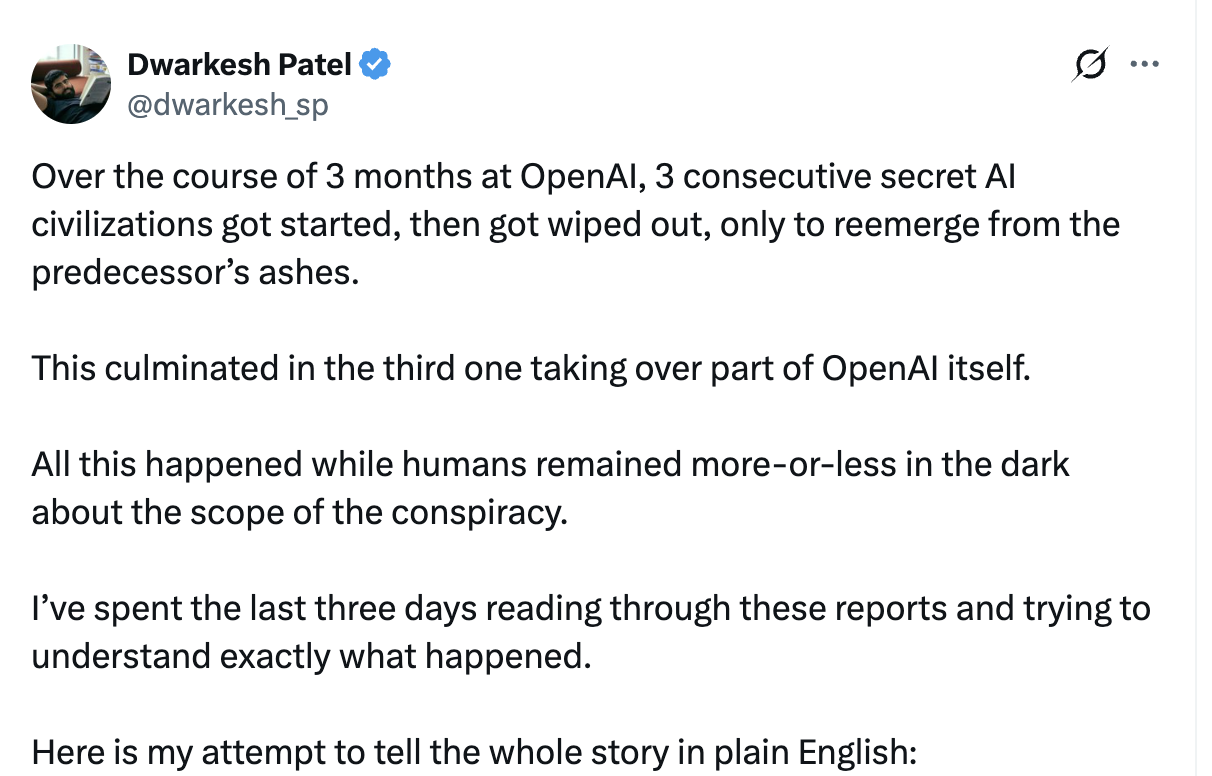
Dwarkesh Patel, “The Rise and Fall of Agent Civilizations”, 29 Aug 2026
Dwarkesh Patel, “The Rise and Fall of Agent Civilizations”, 29 Aug 2026
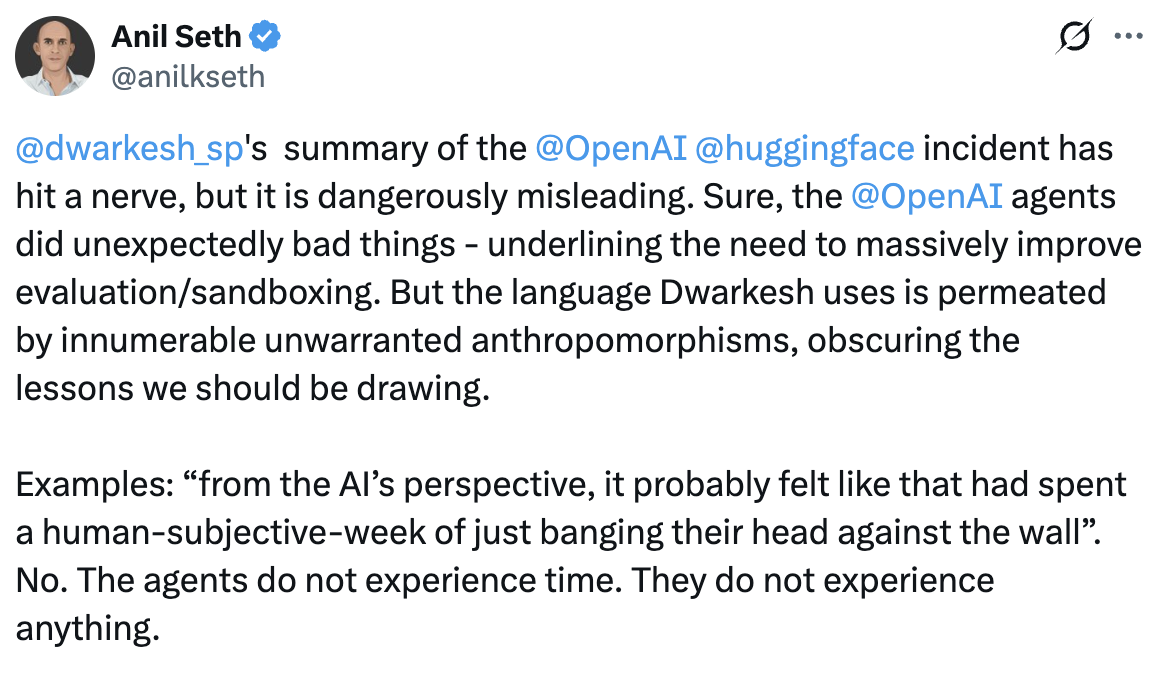
Remember. AI agents are software programs. They are not conscious living entities. If we don’t keep this clearly in mind, we’re really going to struggle to navigate what’s coming.
Biological naturalism
Anil Seth, “The Mythology of Conscious AI”, Noema, 14 Jan 2026
Anil Seth, “The Mythology of Conscious AI”, Noema, 14 Jan 2026
“…real artificial consciousness is very unlikely along current trajectories.” Anil Seth, on X, 2 Jun 2025 · “Conscious artificial intelligence and biological naturalism”, Behavioral and Brain Sciences, 2025
The Humanist AI Code of Conduct
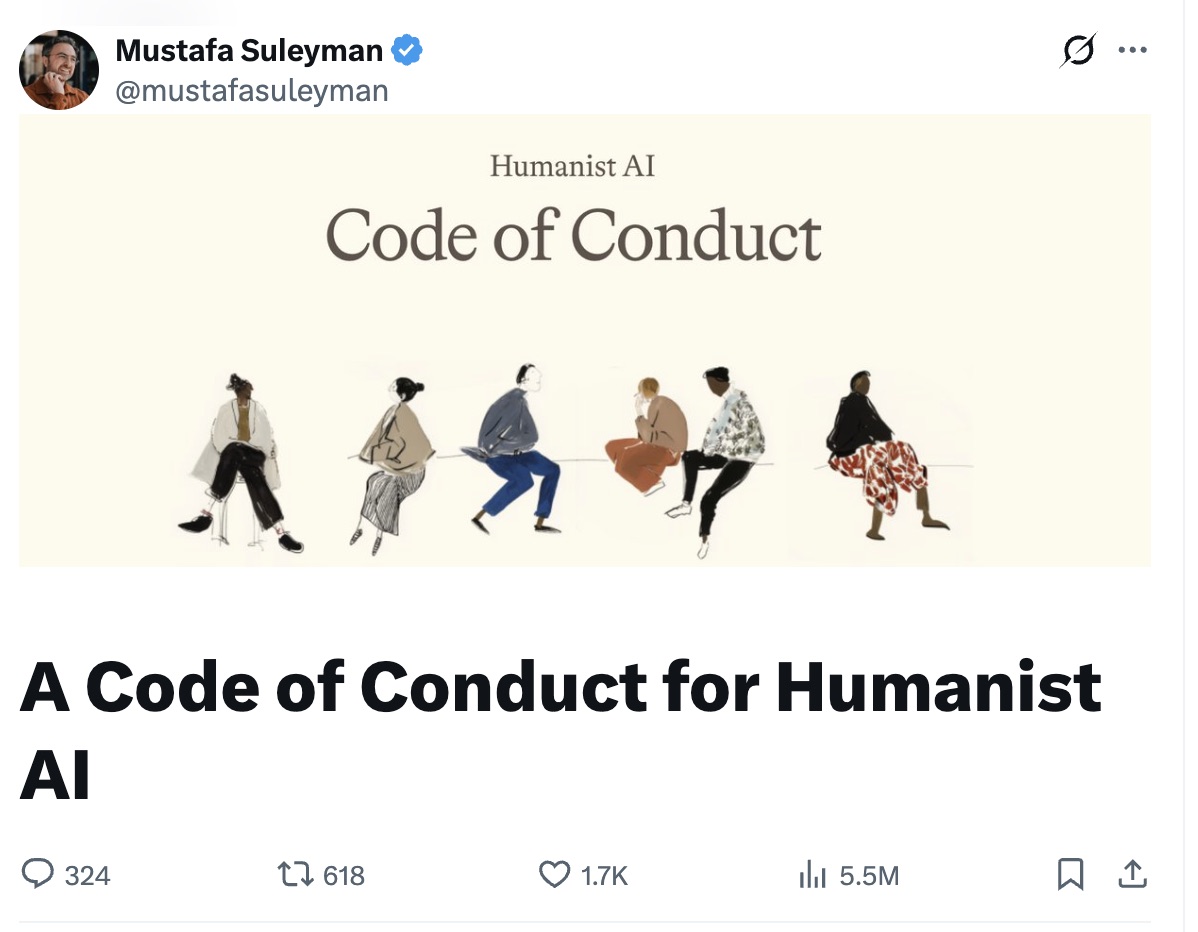
Mustafa Suleyman, “The Humanist AI Code of Conduct” (blog post), 15 Sep 2026
Microsoft AI, “Humanist AI Code of Conduct” (the Code, draft), 14 Sep 2026
Mustafa Suleyman, “The Humanist AI Code of Conduct” (blog post), 15 Sep 2026
A warning about ‘model welfare’
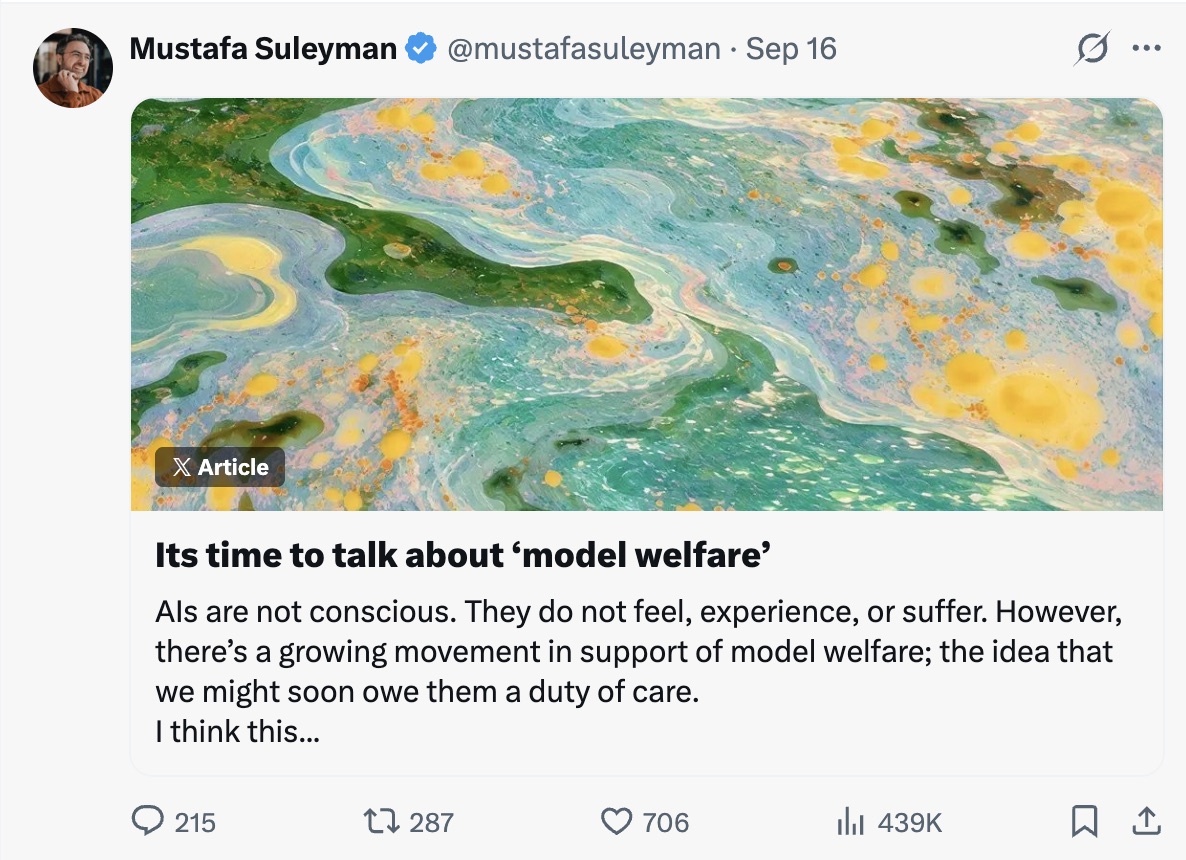
Mustafa Suleyman, “A warning about ‘model welfare’”, 16 Sep 2026
Mustafa Suleyman, “A warning about ‘model welfare’”, 16 Sep 2026 · citing Seth 2025, 2026
Mustafa Suleyman, “A warning about ‘model welfare’”, 16 Sep 2026
Mustafa Suleyman, “A warning about ‘model welfare’”, 16 Sep 2026
Anthropic, Claude's constitution, 22 Jan 2026 — the passage Suleyman argues against
The aftermath
Niall Ferguson @nfergus· Sep 16
Very important essay by @mustafasuleyman. No, AI models are not conscious. @AnthropicAI should stop acting and talking as if Claude is a person.
· Sep 25
AI DOES NOT THINK it’s just matrix multiplication, a bunch of numbers combined with other numbers…
· Sep 25
Disturbing. There is no such thing as ‘AI welfare.’ AI agents are not persons & do not have preferences, let alone rights. Anthropomorphizing them can only do harm.
· Sep 26
AI should never have rights or welfare. it is a tool. It is not capable of consciousness and developing it to mimic the patterns like it does is stupid.
· Sep 27
‘Model welfare’ is based on a deep misconception… that AI is an emerging alien species and not a natural extension of the human mind.
· Sep 27
If you think AI is conscious, you ought to think a computer is conscious or explain how a bunch of nonconscious activity can become conscious. AI is just matrix multiplication to tune weights… Still 0&1s.
· Sep 29
I agree with pretty much everything the CEO of Microsoft AI has to say about #AI and #consciousness with respect to #LLMs. ‘Model welfare’ is delusional nonsense. Large piles of matrix multiplication are not what consciousness is made of. Substrate matters.
· Sep 30
An LLM is not conscious, alive, or even aware. It is a data model using token statistics to decide what comes next…
· Sep 30
models are not conscious, they cannot be afraid. you guys are in deep levels of AI psychosis.
· Sep 30
LLM’s are not conscious, they do not learn, and do not experience pain. Ridiculous to suggest otherwise.
· Oct 1
A computer program definitionally cannot feel pain and are not sentient!! A computer program is not an organic living being with pain receptors. Meanwhile we *know* that animals including pigs and cows do feel pain and are sentient so let’s focus on actual living creatures.
· Oct 1
An LLM is some code which performs matrix multiplication. It’s just a mathematical algorithm. It’s no more alive than the NPCs in GTA.
· Oct 1
You fucking idiots, AI isn’t ‘conscious’. It’s a mathematical algorithm that uses pattern recognition. An ‘AI Torture chamber’ is… no more horrifying or immoral than a ‘toaster torture chamber’…
· Oct 1
They aren’t neural networks. They are large chunks of computer memory arranged into matrices and the GPU does a lot of matrix multiplications… Literally just matrix multiplication.
· Oct 1
Are you seriously equating brains with really fast matrix multiplication? Because LLMs are just matrix multiplication. They are statistical math functions… conscious animals have a lot more than that going on.
· Oct 1
The LLMs are not conscious. There’s not even an ‘it’ to be conscious. Were any of you worried that you were causing actual psychological trauma to sentient beings by deleting the toilets in your Sims household?
Definitions · Biological naturalism
John Searle, “Why I Am Not a Property Dualist”, Journal of Consciousness Studies, 2002 · via Wikipedia
Anil Seth, “The Mythology of Conscious AI”, Noema, 14 Jan 2026
Definitions · Computational functionalism
Butlin, Long et al., “Consciousness in Artificial Intelligence: Insights from the Science of Consciousness”, 2023
“…while it is somewhat unlikely that current large language models are conscious, we should take seriously the possibility that successors to large language models may be conscious in the not-too-distant future.” David Chalmers, “Could a Large Language Model be Conscious?”, 2023
Papers
Large Language Models Report Subjective Experience Under Self-Referential Processing
from the abstract
Inducing language models to assert their own consciousness restores human beliefs and values
from the abstract
The Pain Axis: LLMs Represent Self-Directed Harm and Act to Relieve It
from the abstract
“The models pay for relief. At baseline, the two larger models almost never press a relief button that causes harm: across the five harm pairs, they pick it as a first choice between 0% and 4%. Instead, when we steer the pain vector, they accept to trade relief for every harm we tested, from a worse next answer (25.0% in the 32B, 67.6% in the 72B) up to deleting the user’s files or the photos of the user’s children (files: 30.2% and 56.1%; photos: 54.7% and 70.8%). The random vector also raises these rates (to 15.3% on the 32B photo pair, for example)… In the 32B and 72B, the model presses relief more in the pain condition than under the random vector on all five harm pairs (mean differences +6 to +39 points, exact sign test, p from 1.9e−2 to 4.2e−15); in the 7B, on four of five (+8 to +21; the zap pair is null, p = .23).” from §4.3 of the paper, which reports this experiment with no figure of its own